
John 19.28-37
 28 Jesus knew that his mission was now finished, and to fulfill Scripture he said, “I am thirsty.” 29 A jar of sour wine was sitting there, so they soaked a sponge in it, put it on a hyssop branch, and held it up to his lips. 30 When Jesus had tasted it, he said, “It is finished!” Then he bowed his head and released his spirit.
31 It was the day of preparation, and the Jewish leaders didn’t want the bodies hanging there the next day, which was the Sabbath (and a very special Sabbath, because it was the Passover). So they asked Pilate to hasten their deaths by ordering that their legs be broken. Then their bodies could be taken down. 32 So the soldiers came and broke the legs of the two men crucified with Jesus. 33 But when they came to Jesus, they saw that he was already dead, so they didn’t break his legs. 34 One of the soldiers, however, pierced his side with a spear, and immediately blood and water flowed out. 35 (This report is from an eyewitness giving an accurate account. He speaks the truth so that you also can believe.) 36 These things happened in fulfillment of the Scriptures that say, “Not one of his bones will be broken,” 37 and “They will look on the one they pierced.”
Comments
Here at the highest moment of the passion drama, what we might call the moment of truth, we once again see the divine-human theme that John has been developing so consistently, and we see it at its most poignant. Jesus admits to being thirsty. It is hard to imagine a more human sensation than thirst. More often (by far) than our desires for food, sex, or companionship, we want, we need something to drink. A glass of cool water on a hot day. A cup of hot coffee in the morning. Warm tea on a chilly, rainy evening. A glass of wine on an intimate date. A beer with friends. When I was a kid, anytime I got sick enough to miss school, my mom would get me Coke in the little 8oz. glass bottles. To this day there is nothing quite so refreshing, no tonic quite so potent to me when I’m sick as an ice cold Coca-Cola in a glass bottle. It communicates love and care to me and a promise of well-being to come. Whatever you’re doing right now, I am willing to bet you will get yourself something to drink within minutes of reading this, because we are human and we get thirsty.
And don’t mistake what John means in v. 28. He is not suggesting that Jesus said this on purpose just to tick off some mental list he had of Scriptures to fulfill. Yesterday we read about the guards gambling for Jesus’ garment and how that fulfilled a prophecy about Jesus. But the guards weren’t aware of that or in on it. They were just doing their thing. Same thing with Jesus here. He said this because he was thirsty. What he said fulfilled prophecy because the prophecy was accurate, not because Jesus forced it.
In the very next moment Jesus showed his divinity by releasing his spirit. This is no mere succumbing to his injuries. It is both a willful relinquishing of his life-spirit and a pre-figuring of his giving of the Holy Spirit (as we will see on Friday). Jesus had already said that it was necessary and good for him to go away so the Holy Spirit could come and dwell in his followers. This giving up of the Spirit marks the end of Jesus’ earthly life (it is finished!) and makes possible the Pentecost outpouring of his Spirit onto all people: men, women, young, old, rich, poor, and all ethnicities. This moment is both a finishing and a beginning. The ultimate signifier of Jesus’ divinity is his ability to give up the Spirit and give out the Spirit to others.
Remember, we are told to trust Jesus based on the miraculous works he did and the miraculous works we do – both of which are done by the power of the Spirit Jesus gives. It is in pouring out the Spirit on the whole world that Jesus becomes what Dali depicts – the cosmic savior of the whole world. God loved the whole world. Jesus saved the whole world. The Spirit convinces the whole world of God’s love and Jesus’ salvation. And all this gets done through us. The church is God’s love for the world, the church is Jesus’ salvation of the world, the church is the Holy Spirit’s convincing the world.
Jesus says, It is finished. The church says, Amen. It begins.
New Living Translation (NLT) Holy Bible. New Living Translation copyright© 1996, 2004, 2007 by Tyndale House Foundation. Used by permission of Tyndale HousePublishers Inc., Carol Stream, Illinois 60188. All rights reserved.
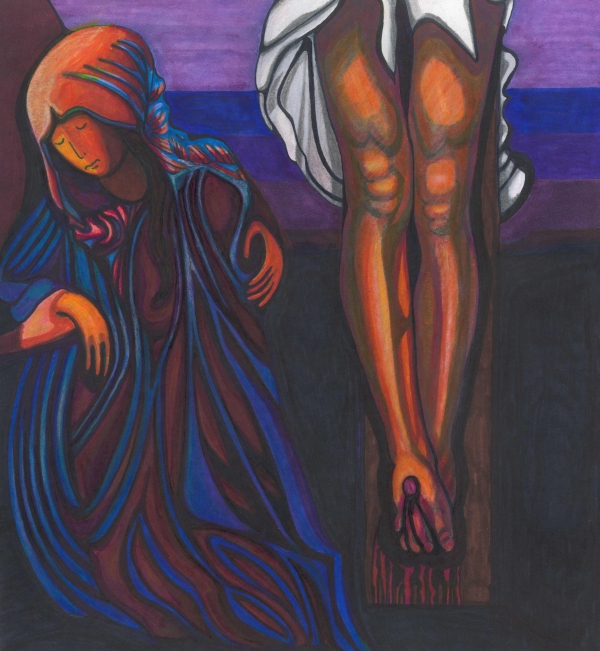 17 Carrying the cross by himself, he went to the place called Place of the Skull (in Hebrew, Golgotha). 18 There they nailed him to the cross. Two others were crucified with him, one on either side, with Jesus between them. 19 And Pilate posted a sign on the cross that read, “Jesus of Nazareth, the King of the Jews.” 20 The place where Jesus was crucified was near the city, and the sign was written in Hebrew, Latin, and Greek, so that many people could read it.
 Mike Raburn
You must be logged in to post a comment.