[I wrote this reflection on the film Birdman after it first came out and then forgot about it. If you haven’t seen it, I recommend it.]
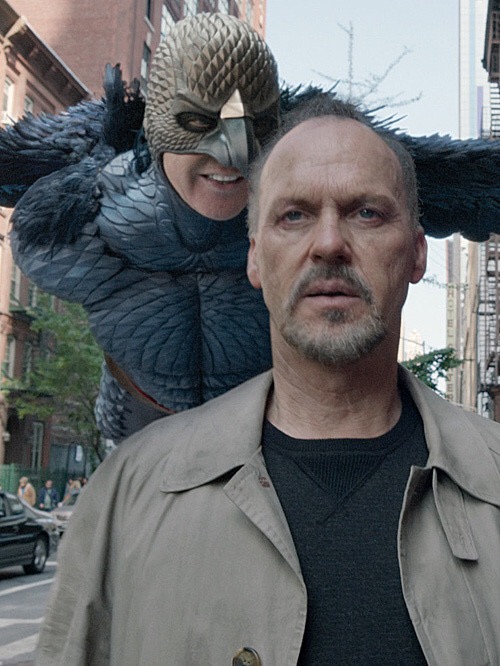 Birdman scared the hell out of me. I really can’t explain that without spoiling the ending (or at least my take on an ending that has sparked much debate), so read on with that spoiler advisory. I made it all the way to the taxi ride scene genuinely unsure if Riggan was hallucinating or not. I figured the old movie poster talking to him was in his head, but I guess I’ve seen enough superhero movies at this point to be insufficiently skeptical of people levitating, using telekinesis, etc. So, yeah, I needed the reveal, which bothers me in the way I think the film wants me to be bothered (more on that in a minute), but that’s not what scared me. I am quite willing to suspend my disbelief and I’m generally okay with that.
What made my eyes bulge and still has me more than a little rattled was the scene at the end (last spoiler warning, you have reached the point of no return) when Riggan jumps out of the hospital window and his daughter looks up (not down to the gory pavement) and her eyes track something in flight. Riggan’s delusion becomes a shared delusion, a social delusion. As a pastor, the idea that I could just be deluded and roping people into a social delusion is incredibly frightening. Those big Emma Stone eyes tracking flight haunt me.
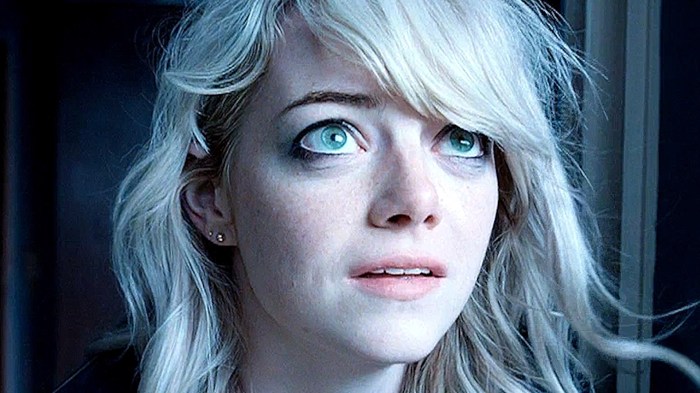 And I take that as one of the film’s main points. I think the film intends to draw our attention to the danger of social delusion, specifically with regard to our obsession with superhero films, which signify nothing, and distract us from reality. The vanity of Riggan’s big budget, billion-dollar-earning superhero movies is called out in a great line, “Billions of flies eat shit everyday. Doesn’t make it good.” The film’s cinematography privileges the present moment and is ironically juxtaposed against its characters who cannot be fully present. Ed Norton’s character can only be real – only present and alive (and aroused) onstage, not in real life. Riggan cannot escape the sound and fury of his superhero past and as a reflection on what that MacBethian adage means for our time, the film is trying to say that our culture is obsessed with mythologies that mean nothing. (And obsession is not too strong a word. As Mark Harris lays out in this excellent Grantland article, we are looking at 75 more of these blockbusters over the next 5 years.) These are our mythology (a set of normative stories); this has become our religion. They get inside our heads and work to make the Shakespeare saw truer than ever, to remove us further from being here, from being present, from being alive. We are already prone to wearing masks as a means to achieving power. Now we have marked this as morally good and truly alive (e.g., Bruce Wayne sleeps through board meetings, Batman is his fully awake state). In short, what if comic book movies are the 21st century iteration of Marx’s opiate for the masses?
But comic book movies aren’t the only potential target of this incisive critique. Any mythology that trades in the supernatural (and don’t they all?) is prone to creating or enabling social delusions, even (perhaps especially) if the given stories are regarded as historically accurate in addition to being vehicles of truth. Of course, there are extreme examples where this dynamic is self-evident (e.g., Jonestown), but part of what makes the Birdman critique so frightening is the implicit claim that this can happen in less overtly extreme, more seemingly innocuous ways and contexts. If the film’s critique is on point (and I think it is), then social delusion is not limited to the realm of extremists, fundamentalists, and highly religious people, it might be the most pervasive and popular dynamic in our cultural marketplace. As a fairly non-religious person and yet a purveyor of what has been accused of being the old formula of Marx’s opium, I take this critique seriously.
These were the thoughts swirling in my head the other day, when my 15 year old daughter shared with me something she heard on a painting podcast. The basic point was religion is bad for painters because it takes you out of the present, distracts you from the moment, disabling you from recognizing and being able to capture the present moment and its attendant beauty. I couldn’t help but think of Riggan and his struggle to create art with that poster bugging him constantly.
If Birdman offers any hope, it would be in the art which Riggan aspires to but which the film reserves for itself, over against Riggan’s blockbusters or his ill-fated Broadway effort. Art is a mirror, not only of nature and society, but of our very selves. In attempting the play, Riggan is trying to recreate his own identity, to shed his superhero cowl, and find/make a truer version of himself. This is made difficult in a culture where masked identities are glorified and the quest to know thyself is most often construed as yet another path to superhuman power. But self-understanding cannot serve as a means to some other end, it only makes sense as an end unto itself. Riggan’s noble intentions for the play devolve into trading one vanity (Birdman success) for another (critical acclaim).
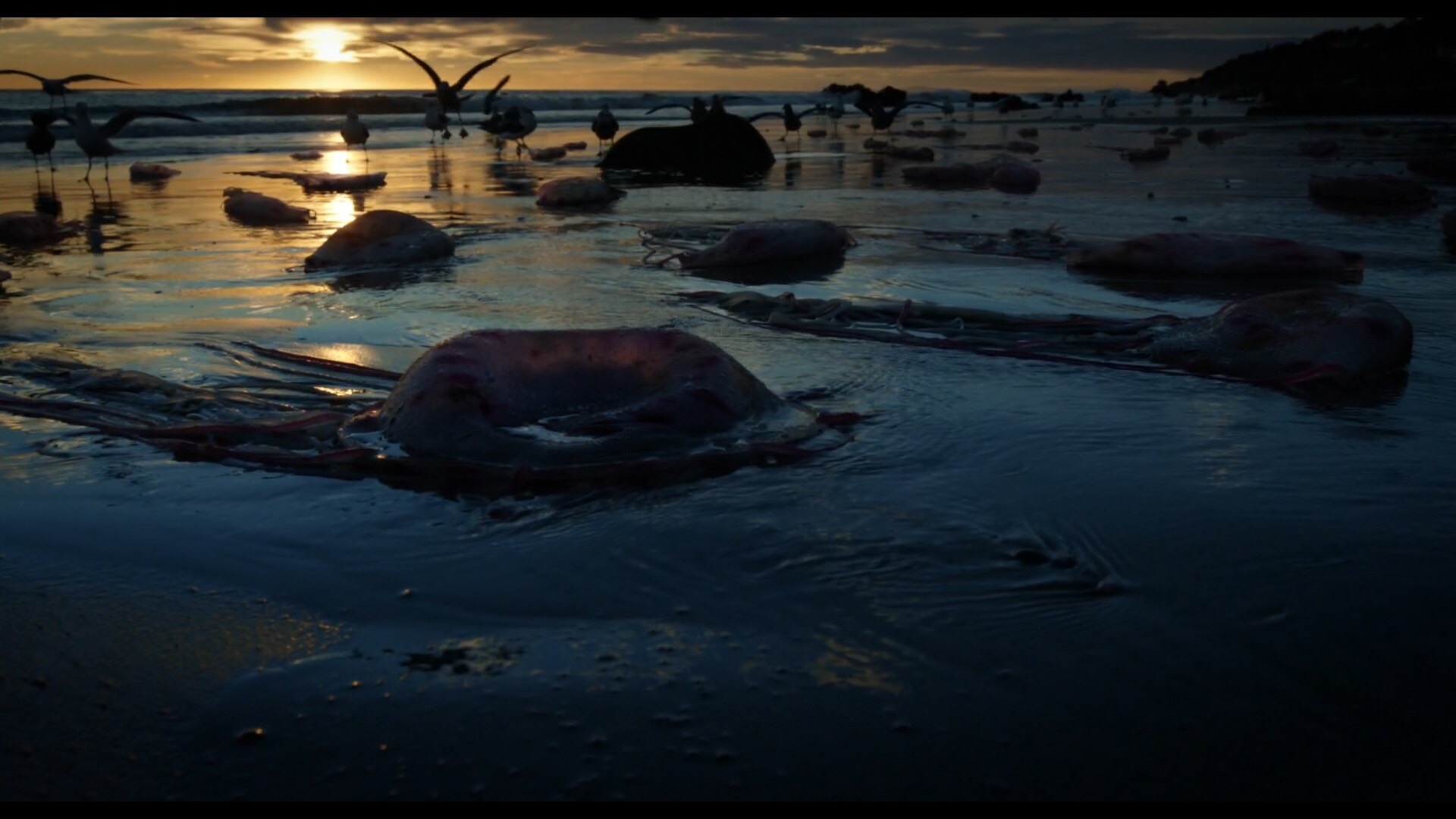
 The solution for the painter and for Riggan is to commit to being fully present in each moment, to embrace all the present has, especially suffering. Buddha’s first noble truth is that reality is known by suffering. The flashes of the beached jellyfish are our clue to the importance of the story/exposition sandwich Riggan offers his ex-wife just prior to his (second) suicide attempt. It is in suffering that he comes alive. Even his birth into the social media world comes through suffering, the common nightmare of being in public in your underwear, magnified to Times Square level. The film takes that moment to critique social media as another realm of shared delusion which both gives the illusion of power to the masses and demonstrates our nothingness, our nobodyness, the vanity and futility of all our lives. Pain wakes us up and exposes our delusions for the falsehoods they are. Life is marked by suffering and suffering names our attachment to our desires all which go ultimately unfulfilled. Our inability to confront those noble truths leaves us clinging to various delusions. The final hallucination comes as Riggan recuperates, his suffering ended, the delusions resume. (I can’t even go into the recent story about Johnny Depp being in the first draft of the ending. Making this whole thing purgatory either seals the suffering point or puts the delusional state in a fatalistic cycle of destiny. I’m glad they changed it. Even Emma Stone staring at a mirage is better than that.)
This seems like a timely cultural critique. We live in a world of superheros. Sports stars, celebrities, one percenters, megachurch pastors. We’ve even turned “creatives” into a type of superhero. As a (non-mega) pastor, the possibility that I might be perpetuating a social delusion genuinely scares me. What if it is all a lot of sound and fury signifying nothing? Even if that’s not existentially the case, what if all we’re creating is insignificant noise and angst? I can’t be the only one worried about that, right? And, frankly, I find the film’s perspective as inward and myopic as Riggan’s. Except the subtitle, “The Unexpected Virtue of Ignorance,” makes me think the film is intentionally myopic. It drives home the point that ignorance is only a virtue in a culture where knowledge, especially self-knowledge, is not valued. The only exit from this feedback loop of vanities, from the delusional masked states of our revelery, is suffering the sort of stinging pain delivered to us either by jellyfish or by a biting critique like Birdman tries to land.
In a happy coincidence, another thing I heard as I was thinking through all this was a wise old pastor say that what defines a community of faith is shared suffering. We bear each other’s burdens. We learn together to be fully, completely, painfully present to each other in each moment. The only alternative seems to be a shared delusional state around some mythology or other that facilitates disengagement from the particularities of our existence. That rings true to me and makes Birdman a cautionary tale I’m glad flew my way.

 Our church may be small (75 people) but we’re sending 17 kids to youth camp this. Camp Vineyard outside Atlanta is a great experience. The cost is $300 per kid and I need your help covering the cost for kids who can’t afford that. We needed $2400 but I put the word out on Facebook yesterday and raised $400 right away. We still need $2000. I will update this post as we get more donations.


 Mike Raburn
You must be logged in to post a comment.