Red Letter Year: 10/23

John 6.56-71

498329513_42b18acdc2_z
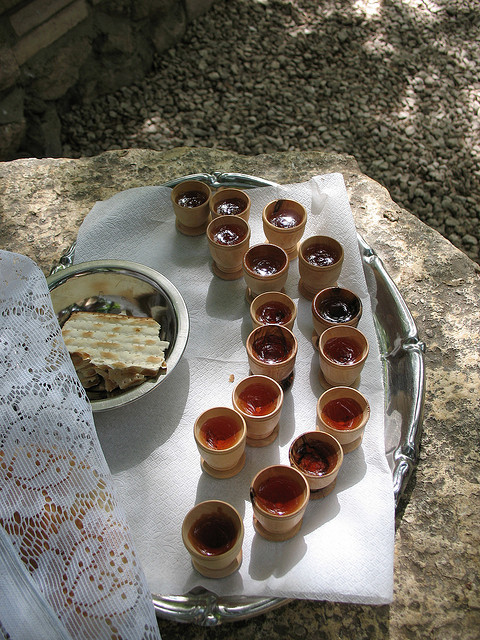
Photo by James Emery
http://www.flickr.com/photos/emeryjl/

56 Anyone who feasts on my flesh and drinks my blood remains in me, and I in him. 57 I live because of the living Father who sent me; in the same way, anyone who feeds on me will live because of me. 58 I am the true bread that came down from heaven. Anyone who eats this bread will not die as your ancestors did (even though they ate the manna) but will live forever.”

59 He said these things while he was teaching in the synagogue in Capernaum.

60 Many of his disciples said, “This is very hard to understand. How can anyone accept it?”

61 Jesus was aware that his disciples were complaining, so he said to them, “Does this offend you? 62 Then what will you think if you see the Son of Man ascend to heaven again? 63 The Spirit alone gives eternal life. Human effort accomplishes nothing. And the very words I have spoken to you are spirit and life. 64 But some of you do not trust me.” (For Jesus knew from the beginning which ones didn’t believe, and he knew who would betray him.) 65 Then he said, “That is why I said that people can’t come to me unless the Father gives them to me.”

66 At this point many of his disciples turned away and deserted him. 67 Then Jesus turned to the Twelve and asked, “Are you also going to leave?”

68 Simon Peter replied, “Lord, to whom would we go? You have the words that give eternal life. 69 We believe, and we know you are the Holy One of God.”

70 Then Jesus said, “I chose the twelve of you, but one is a devil.” 71 He was speaking of Judas, son of Simon Iscariot, one of the Twelve, who would later betray him.

Comments

Yesterday we looked at the claim Jesus made that each person is taught by God. This idea is prevalent in both the Hebrew and Christian Scriptures, but it makes some people very uncomfortable because it makes everything seem so subjective. I made the case that subjectivity is inherent to our nature, that revelation specifically names God entering into the realm of our subjectivity to communicate with us in the only way possible for us.

I do think this is an accurate description of the human condition and God’s manner of reaching out to us, but I also think it rubs against something else fundamental to our nature: a longing for objective truth, a longing for absolutes. Most people get very uncomfortable if they feel like nothing is secure. If everything is up for grabs, if there is no solid ground to stand on, then we are left feeling adrift, untethered from anything we can recognize as real or true. I added a comment yesterday quoting Bede Griffiths and it bears repeating here:

“The intellect, in and beyond every formulation by which it seeks to express its thought, is in search of the Absolute. It is made for Being itself, for Truth, for Reality, and it cannot rest satisfied in any partial truth, in any construction of the human mind.” (Bede Griffiths, Return to the Centre, p.74)

This sums up both the point from yesterday and the one I’m about to make. We cannot be satisfied with any partial truth, with anything our minds have constructed, with what I called perceived truth. We are not only subjective creatures, we are also creatures whose intellects naturally look beyond anything in this realm seeking for the Absolute.

We are subjective. But we want objective. Our thinking tends to abstraction. But we want concreteness. In today’s reading Jesus gives us just this. We eat his body. We drink his blood. He is the Word become flesh, the body become bread, the blood become wine. The bread IS his body. The wine IS his blood. The Absolute we long for, the concrete we need, what we want to touch and see and taste is the Eucharist, the Lord’s Table, Holy Communion. Jesus encourages us to chomp down (the Greek word in v.56 is trogon – a word created to mimic the sound of animals eating nosily) to fill our need for objectivity with the most concrete reality he had to offer us.

And this really works if you think about it. Christians the world over hold very different theological views about, well, everything. About Jesus, God, salvation, the church, heaven, hell, you name it. And yet, as often as we take the Meal, almost all of us say the exact same thing: “the body of Christ broken for you, the blood of Christ poured out for you.” One reason the early church encouraged the Meal at every service was no matter how bad the sermon was, if the Meal was shared, the Gospel was preached, because the Gospel is summed up right there. Even our differences in understanding regarding what happens in the Meal give way to the objective, absolute, existential truth: this bread is the body of Christ broken for you, take and eat it; this wine is the blood of Christ poured out for you, drink all of it.

We all long for objective truth. Thankfully, Jesus has prepared us a meal that satisfies.

New Living Translation (NLT) Holy Bible. New Living Translation copyright© 1996, 2004, 2007 by Tyndale House Foundation. Used by permission of Tyndale HousePublishers Inc., Carol Stream, Illinois 60188. All rights reserved.
Taught by God: Red Letter Year 10/22

John 6.41-55

41 Then the people began to murmur in disagreement because he had said, “I am the bread that came down from heaven.” 42 They said, “Isn’t this Jesus, the son of Joseph? We know his father and mother. How can he say, ‘I came down from heaven’?”

43 But Jesus replied, “Stop complaining about what I said. 44 For no one can come to me unless the Father who sent me draws them to me, and at the last day I will raise them up. 45 As it is written in the Scriptures, ‘They will all be taught by God.’ Everyone who listens to the Father and learns from him comes to me. 46 Not that anyone has ever seen the Father; only I, who was sent from God, have seen him. 47 I tell you the truth, anyone who believes has eternal life. 48 Yes, I am the bread of life! 49 Your ancestors ate manna in the wilderness, but they all died. 50 Anyone who eats the bread from heaven, however, will never die. 51 I am the living bread that came down from heaven. Anyone who eats this bread will live forever; and this bread, which I will offer so the world may live, is my flesh.”

52 Then the people began arguing with each other about what he meant. “How can this man give us his flesh to eat?” they asked.

53 So Jesus said again, “I tell you the truth, unless you eat the flesh of the Son of Man and drink his blood, you cannot have eternal life within you. 54 But anyone who eats my flesh and drinks my blood has eternal life, and I will raise that person at the last day. 55 For my flesh is true food, and my blood is true drink.”

Comments

Jesus says, “they will all be taught by God.” More than just saying it, he is also quoting Isaiah:

“I [God] will teach all your children, and they will enjoy great peace.”

And this idea of people being taught directly by God is not unique to these two passages. Check out these others:

Jeremiah 31.33-34: “I will put my instructions deep within them, and I will write them on their hearts. I will be their God, and they will be my people. And they will not need to teach their neighbors, nor will they need to teach their relatives, saying, ‘You should know the Lord.’ For everyone, from the least to the greatest, will know me already,” says the Lord.

Jesus talking to Peter in Matt. 16.17: “You are blessed, Simon son of John, because my Father in heaven has revealed this to you. You did not learn this from any human being.”

Paul discussing himself in Gal. 1.11-12: “Dear brothers and sisters, I want you to understand that the gospel message I preach is not based on mere human reasoning. I received my message from no human source, and no one taught me. Instead, I received it by direct revelation from Jesus Christ.”

Paul writing to and about the church in Thessalonica in 1 Thes. 4.9: “But we don’t need to write to you about the importance of loving each other, for God himself has taught you to love one another.”

As we begin to see in our John passage (and will see more fully tomorrow), the people listening to Jesus were quite disturbed by the idea of eating his body. They weren’t up for cannibalism and failed to understand the importance of what Jesus was saying. He was talking about his coming sacrifice of his body for our benefit and he was also talking about how this gets applied to us directly – without mediation – how we are fed directly by Jesus. We are taught directly by God.

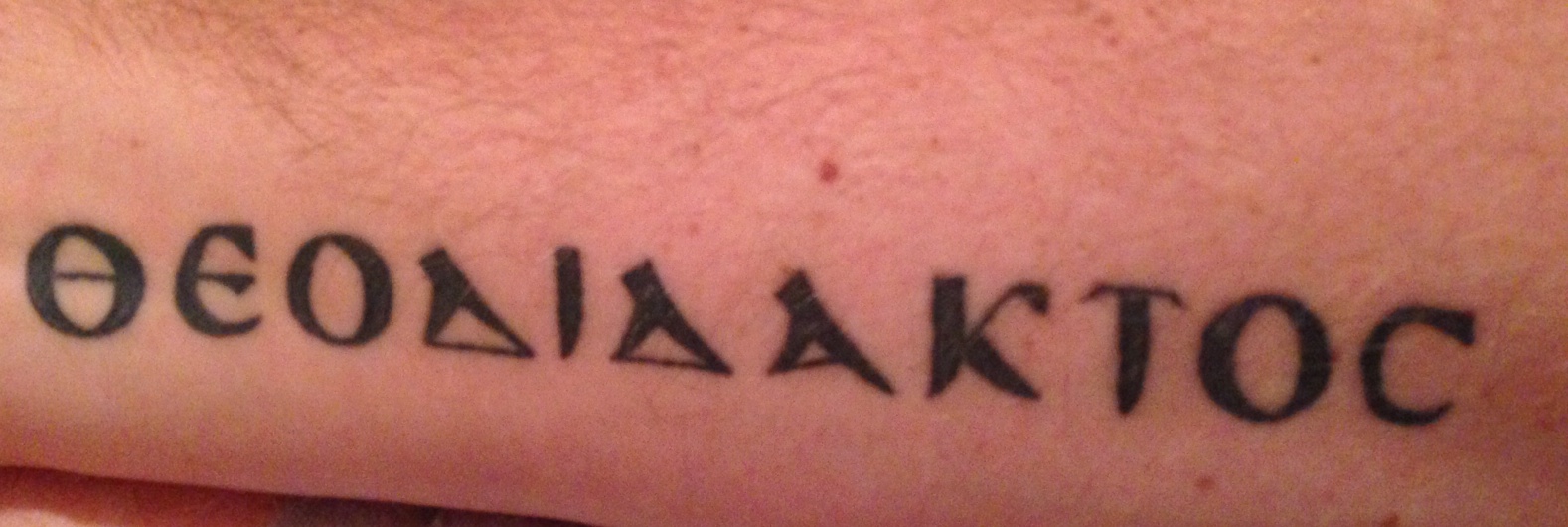
This really is the very foundation of my own theological understanding, that each person is taught by God directly. This is what Paul was telling the church in Thessalonica: ‘you don’t need me to tell you, God has taught you.’ Paul says this by calling them a name in Greek: theodidaktoi – “the taught-by-God ones.” And this is who we are. All of us. We either learn it from God directly or we don’t know it at all. The role of teachers and pastors is not to tell you, but help open your spiritual ears to hear what the Spirit is saying to you, to encourage you to open your heart to being taught by God. This is so important to me, I made sure I would never forget it:

photo-6

All religious/faith/theological understanding is about negotiating two things: perceived truth and revealed truth. What we think is true versus what God tells us is true. Notice I haven’t used any capital t’s yet. Why? Because there is only one Truth and that is the person of Jesus Christ. Jesus is the fulness of God revealed to humans and also the fulness of humanity revealed to humans. He is the God-man and the only capital-t Truth. Everything else (which includes our understanding of Jesus) exists in the negotiation between what we think is true and what God teaches us is true.

Wait a minute, you might say, what about objectivity? Is this all relative and subjective? Not quite. There is an objective Truth. His name is Jesus. But everything else is subjective because we are subjective creatures and everything we think, everything we know, everything we think we know resides within our understanding, which is altogether subjective. This might make it sound like there is an insurmountable barrier between us and truth. But there’s not. Our subjectivity is not a negative quality or something God has to get around to teach us. It is the nature of how we understand because all our learning is relational – by design. We were created for relationship with God (and with each other) and a primary quality of this relationship is God teaching and us learning (and also us learning in community in ways that respect the primacy of each learning from God).

Another thing we find is that God is very selective in what to share with each of us. When we get to the end of John, we will read this exchange between Peter and Jesus:

21.20-22: Peter turned around and saw behind them the disciple Jesus loved—the one who had leaned over to Jesus during supper and asked, “Lord, who will betray you?” Peter asked Jesus, “What about him, Lord?” Jesus replied, “If I want him to remain alive until I return, what is that to you? As for you, follow me.”

I am pretty sure this is an essential part of Jesus revealing God’s nature to us, that God has a basic “none of your business” policy that applies to things that are, well, none of our business. What do I mean? Just this: God only reveals things to us that directly relate to us personally. God won’t convict me of your sin, or tell you how I should conduct my life. There are exceptions to this, but they relate specifically to people we are doing life with (e.g., pastoral ministry, prophetic words in small groups) and even then the scope is very limited. For the most part, God reserves the right to teach each of us directly. Because God’s words are spirit and life and the goal is for all of us to be theodidaktoi.

If you think about it, this has far reaching implications for how we deal with each other, especially with people whose theology or ‘lifestyle’ we disagree with. We will often find that what God has taught one is not what God has taught another. God will even forbid one person to do something that another person is allowed to do. Even clear cut commandments have to be taught to us by God. The Ten Commandments include prohibitions on killing and lying, but God directed the Israelites to do a lot of killing not long after issuing this command and those who hid Jews and lied to Nazis were doing the opposite of sinning. I know we desperately want a definitive, black and white set of rules to follow. But what God wants is relationship with us. God wants to teach us, to lead us, to grow us, not to leave us alone to our own devices, especially not our own religious devices.

Eat the body of Jesus. Learn directly from the Bread of Life. Be a theodidaktos. You may as well, because if God hasn’t taught you, you don’t know yet.

New Living Translation (NLT) Holy Bible. New Living Translation copyright© 1996, 2004, 2007 by Tyndale House Foundation. Used by permission of Tyndale HousePublishers Inc., Carol Stream, Illinois 60188. All rights reserved.