
John 2.13-25
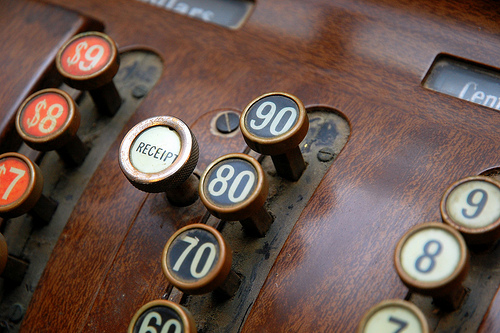
http://www.flickr.com/photos/stevensnodgrass/4034636727/
13 It was nearly time for the Jewish Passover celebration, so Jesus went to Jerusalem. 14 In the Temple area he saw merchants selling cattle, sheep, and doves for sacrifices; he also saw dealers at tables exchanging foreign money. 15 Jesus made a whip from some ropes and chased them all out of the Temple. He drove out the sheep and cattle, scattered the money changers’ coins over the floor, and turned over their tables. 16 Then, going over to the people who sold doves, he told them, “Get these things out of here. Stop turning my Father’s house into a marketplace!”
17 Then his disciples remembered this prophecy from the Scriptures: “Passion for God’s house will consume me.”
18 But the Jewish leaders demanded, “What are you doing? If God gave you authority to do this, show us a miraculous sign to prove it.”
19 “All right,” Jesus replied. “Destroy this temple, and in three days I will raise it up.”
20 “What!” they exclaimed. “It has taken forty-six years to build this Temple, and you can rebuild it in three days?” 21 But when Jesus said “this temple,” he meant his own body. 22 After he was raised from the dead, his disciples remembered he had said this, and they believed both the Scriptures and what Jesus had said.
23 Because of the miraculous signs Jesus did in Jerusalem at the Passover celebration, many began to trust in him. 24 But Jesus didn’t trust them, because he knew human nature. 25 No one needed to tell him what mankind is really like.
Comments
This is the fourth time we’ve read about Jesus clearing the Temple. A couple of key differences stand out in John’s telling. One is the placement in the overall narrative. The other three put this episode near the very end of their stories, just days before Jesus is arrested. John moves it all the way up to the beginning. At this point, I hope you have developed a habit of seeing a discrepancy like this and automatically asking, ‘what point is John trying to make with this move?’ That is the right question to ask. Asking when is actually occurred is a. not something we can determine, and b. not important. This episode happened and each writer uses the story to further his own narrative. The other three use this (to varying degrees) as an immediate explanation for why Jesus was arrested and put to death. John brings it forward and places it along side the wine making miracle to make a different point (we will have to see later what precipitates the arrest in John’s account).
The second difference here also relates to John’s point in moving this story forward, so let me mention it before offering my take on what John is up to here. Mark, Matthew, and Luke all have Jesus saying the exact same thing, “My house will be called a house of prayer, but you have made (are making) it a den of robbers.” This is not what John records. He has Jesus say, “Take these things away, you shall not make my Father’s house a shopping mall.” When we were in Luke, I shared how the Temple was literally being used as storage for stolen treasure (click here to read that post). But John goes well beyond that. Jesus is not just critiquing the exploitation of the people by their religious leaders, he is critiquing the entire approach to faith that is transactional in nature as opposed to social and communal in nature. The religious system the Ebionites sought to impose was not one that fostered relationship with God, rather it sought to appease God with manageable amounts of commerce.
By positioning these two stories at the beginning of his Gospel, John is highlighting the difference between a relational approach to faith, which Jesus blesses (with 150 gallons of wine no less), versus a transactional approach, which Jesus fiercely opposes. Even the response of the leaders bears this out. They demand a sign (another transaction) and betray a preoccupation with the building Caesar had paid for to appease them and buy their compliance.
I told you last week I think John might have the most to say to us, that the church (at least in America) might be closer to Ebionitism than anything else, and this shows what I’m talking about. The “Christian marketplace” we have right now is a disturbing parallel to what Jesus wrecked and called a shopping mall in this passage. Our ‘best’ and ‘brightest’ leaders are the ones who can sell books, repackage their content and sell more books, repackage it again and make it into a DVD series, repackage it again for a speaking tour. If you pay close enough attention, you can see that many of these folks are following the same playbook, the same marketing strategy, and it is one designed to maximize sales and profit, crafted to develop a ‘platform’ which can be used for self-promotion, establishing various revenue streams from the same recycled content. I have been watching this process closely for a few years now and there is something deeply troubling about it.
But I have to confess, I have been studying it so I could join in the parade, set up my own booth at the mall and sell my wares too. Hey, graduate school was expensive, I have a family to take care of, and I want to succeed as much as anyone. So I feel weird even writing this. I’m not sure I can say exactly what is wrong with the system of marketing and promotion being used right now. I’m not sure exactly why the phrase “Christian marketplace” makes my skin crawl. I can tell you honestly, I am working with a publisher right now to turn my dissertation into a book, to publish an old Barth book I translated from German, and hopefully to publish both these Red Letter Year reflections and the Lent Heart Prayers I wrote earlier in the year. I have put a lot of work into all of this stuff, and yes, I hope they all get published, and I hope they sell like crazy. It won’t hurt my feelings at all if one of my books winds up on the shelf at your local Wal-Mart. If that happens, I will have “made it” – right?
So why is it I think Jesus is looking at our “Christian marketplace” the same way he looked at the market they had set up in the Temple? Why is it that one of my biggest heroes, Rich Mullins, intentionally walked away after his most successful album (A Liturgy, A Legacy, and a Ragamuffin Band), went to live on a reservation and taught native American kids music as an act of rejection of the “Christian marketplace?” What did Rich understand that so many others, chasing the American dream and using the Gospel as a means to that end, have failed to grasp? I really don’t have answers here, and I’m afraid of my own ambition as much as anything.
I don’t usually get many comments on these (though views are up – – see what I did there? It’s true, I check my blog numbers a lot more than is healthy. Sigh.) but I would love to get your thoughts on this one. Have we sold out the Gospel? Has a transactional understanding of our relationship with God tainted everything? If so, how do we confront it? How do we clear the Temple? Come on, talk to me.
New Living Translation (NLT) Holy Bible. New Living Translation copyright© 1996, 2004, 2007 by Tyndale House Foundation. Used by permission of Tyndale HousePublishers Inc., Carol Stream, Illinois 60188. All rights reserved.
 1The next day there was a wedding celebration in the village of Cana in Galilee. Jesus’ mother was there, 2 and Jesus and his disciples were also invited to the celebration. 3 The wine supply ran out during the festivities, so Jesus’ mother told him, “They have no more wine.”
 Mike Raburn
You must be logged in to post a comment.