Red Letter Year: 10/24

John 7.1-13

Courtesy of Thomas Hawk http://www.flickr.com/photos/thomashawk/4565615056/
Courtesy of Thomas Hawk
http://www.flickr.com/photos/thomashawk/4565615056/

7 After this, Jesus traveled around Galilee. He wanted to stay out of Judea, where the Jewish leaders were plotting his death. 2 But soon it was time for the Jewish Festival of Shelters, 3 and Jesus’ brothers said to him, “Leave here and go to Judea, where your followers can see your miracles! 4 You can’t become famous if you hide like this! If you can do such wonderful things, show yourself to the world!” 5 For even his brothers didn’t trust him.

6 Jesus replied, “Now is not the right time for me to go, but you can go anytime. 7 The world can’t hate you, but it does hate me because I accuse it of doing evil. You go on. I’m not going to this festival, because my time has not yet come.” 9 After saying these things, Jesus remained in Galilee.

10 But after his brothers left for the festival, Jesus also went, though secretly, staying out of public view. 11 The Jewish leaders tried to find him at the festival and kept asking if anyone had seen him.12 There was a lot of grumbling about him among the crowds. Some argued, “He’s a good man,” but others said, “He’s nothing but a fraud who deceives the people.” 13 But no one had the courage to speak favorably about him in public, for they were afraid of getting in trouble with the Jewish leaders.

Comments

When we started reading John, I told you that one of the main themes is the world’s hostility to God. We have seen glimpses of this already, but over chapters 7 and 8, we are going to see this fully expressed. Jesus is opposed by a variety of people, ranging from those very close to him (his own brothers today) to authorities distant from him. John uses these conflicts to more clearly define both the nature of the world’s hostility and the nature of God’s loving response, as Jesus refuses to be defined by the world or its hostility.

We see this played out in today’s reading and we also see a good example of why we are using “trust” instead of “believe in” to translate the Greek word pisteuo. If we read, “For even his brothers didn’t believe in him,” that suggests they were skeptical about his claims and/or his miracles. But this is clearly wrong since they advise him to take his show on the road to the big city so everyone can see his miracles and buy into his claim. What his brothers fail to do is to trust that Jesus knows what he is doing, that he is taking the proper approach to using his powers and fulfilling his role as Messiah.

Jesus’ power is not the issue here. Jesus’ way is the problem. The brothers give good, common sense advice. They point Jesus down the road of success. Their way would make him famous. But common sense is not Jesus sense. Success strategies are not the cross strategy. The world is fine with power, with miracles, even with believing in things. All those can be made to fit within what we call success. But waiting, timing, self-sacrifice, and trust don’t fit at all. Jesus refused to settle for establishing a cult of personality because those never overcome the world’s hostility, they capitulate to it, exploit it for personal gain, and thus only re-entrench it. The world’s hostility – our hostility, yes we all share in it – is only overcome by love that gives itself away freely. This is what we are called to trust – and by trust I mean participate in. 

There is a lesson here for the (especially American) church. I hope we don’t miss it.

New Living Translation (NLT) Holy Bible. New Living Translation copyright© 1996, 2004, 2007 by Tyndale House Foundation. Used by permission of Tyndale HousePublishers Inc., Carol Stream, Illinois 60188. All rights reserved.
Red Letter Year: 10/23

John 6.56-71

498329513_42b18acdc2_z
Photo by James Emery
http://www.flickr.com/photos/emeryjl/

56 Anyone who feasts on my flesh and drinks my blood remains in me, and I in him. 57 I live because of the living Father who sent me; in the same way, anyone who feeds on me will live because of me. 58 I am the true bread that came down from heaven. Anyone who eats this bread will not die as your ancestors did (even though they ate the manna) but will live forever.”

59 He said these things while he was teaching in the synagogue in Capernaum.

60 Many of his disciples said, “This is very hard to understand. How can anyone accept it?”

61 Jesus was aware that his disciples were complaining, so he said to them, “Does this offend you? 62 Then what will you think if you see the Son of Man ascend to heaven again? 63 The Spirit alone gives eternal life. Human effort accomplishes nothing. And the very words I have spoken to you are spirit and life. 64 But some of you do not trust me.” (For Jesus knew from the beginning which ones didn’t believe, and he knew who would betray him.) 65 Then he said, “That is why I said that people can’t come to me unless the Father gives them to me.”

66 At this point many of his disciples turned away and deserted him. 67 Then Jesus turned to the Twelve and asked, “Are you also going to leave?”

68 Simon Peter replied, “Lord, to whom would we go? You have the words that give eternal life. 69 We believe, and we know you are the Holy One of God.”

70 Then Jesus said, “I chose the twelve of you, but one is a devil.” 71 He was speaking of Judas, son of Simon Iscariot, one of the Twelve, who would later betray him.

Comments

Yesterday we looked at the claim Jesus made that each person is taught by God. This idea is prevalent in both the Hebrew and Christian Scriptures, but it makes some people very uncomfortable because it makes everything seem so subjective. I made the case that subjectivity is inherent to our nature, that revelation specifically names God entering into the realm of our subjectivity to communicate with us in the only way possible for us.

I do think this is an accurate description of the human condition and God’s manner of reaching out to us, but I also think it rubs against something else fundamental to our nature: a longing for objective truth, a longing for absolutes. Most people get very uncomfortable if they feel like nothing is secure. If everything is up for grabs, if there is no solid ground to stand on, then we are left feeling adrift, untethered from anything we can recognize as real or true. I added a comment yesterday quoting Bede Griffiths and it bears repeating here:

“The intellect, in and beyond every formulation by which it seeks to express its thought, is in search of the Absolute. It is made for Being itself, for Truth, for Reality, and it cannot rest satisfied in any partial truth, in any construction of the human mind.” (Bede Griffiths, Return to the Centre, p.74)

This sums up both the point from yesterday and the one I’m about to make. We cannot be satisfied with any partial truth, with anything our minds have constructed, with what I called perceived truth. We are not only subjective creatures, we are also creatures whose intellects naturally look beyond anything in this realm seeking for the Absolute.

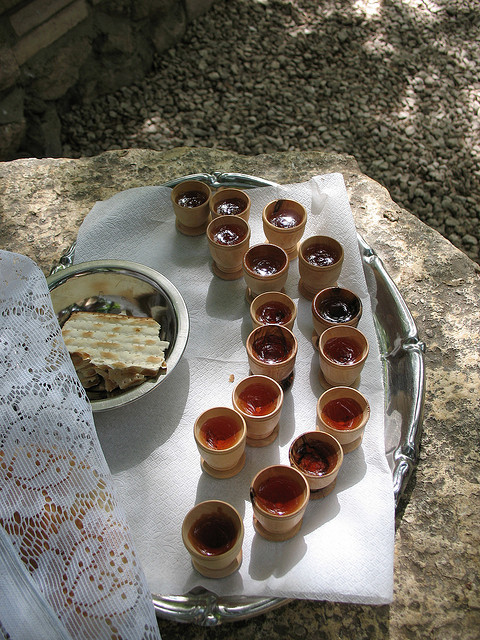
We are subjective. But we want objective. Our thinking tends to abstraction. But we want concreteness. In today’s reading Jesus gives us just this. We eat his body. We drink his blood. He is the Word become flesh, the body become bread, the blood become wine. The bread IS his body. The wine IS his blood. The Absolute we long for, the concrete we need, what we want to touch and see and taste is the Eucharist, the Lord’s Table, Holy Communion. Jesus encourages us to chomp down (the Greek word in v.56 is trogon – a word created to mimic the sound of animals eating nosily) to fill our need for objectivity with the most concrete reality he had to offer us.

And this really works if you think about it. Christians the world over hold very different theological views about, well, everything. About Jesus, God, salvation, the church, heaven, hell, you name it. And yet, as often as we take the Meal, almost all of us say the exact same thing: “the body of Christ broken for you, the blood of Christ poured out for you.” One reason the early church encouraged the Meal at every service was no matter how bad the sermon was, if the Meal was shared, the Gospel was preached, because the Gospel is summed up right there. Even our differences in understanding regarding what happens in the Meal give way to the objective, absolute, existential truth: this bread is the body of Christ broken for you, take and eat it; this wine is the blood of Christ poured out for you, drink all of it.

We all long for objective truth. Thankfully, Jesus has prepared us a meal that satisfies.

New Living Translation (NLT) Holy Bible. New Living Translation copyright© 1996, 2004, 2007 by Tyndale House Foundation. Used by permission of Tyndale HousePublishers Inc., Carol Stream, Illinois 60188. All rights reserved.