Mark 14:32-52
32 They went to the olive grove called Gethsemane, and Jesus said, “Sit here while I go and pray.”33 He took Peter, James, and John with him, and he became deeply troubled and distressed. 34 He told them, “My soul is crushed with grief to the point of death. Stay here and keep watch with me.”
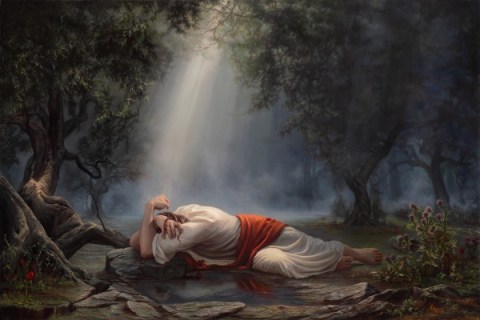 35 He went on a little farther and fell to the ground. He prayed that, if it were possible, the awful hour awaiting him might pass him by. 36 “Abba, Father,” he cried out, “everything is possible for you. Please take this cup of suffering away from me. Yet I want your will to be done, not mine.”
37 Then he returned and found the disciples asleep. He said to Peter, “Simon, are you asleep? Couldn’t you watch with me even one hour? 38 Keep watch and pray, so that you will not give in to temptation. For the spirit is willing, but the body is weak.”
39 Then Jesus left them again and prayed the same prayer as before. 40 When he returned to them again, he found them sleeping, for they couldn’t keep their eyes open. And they didn’t know what to say.
41 When he returned to them the third time, he said, “Go ahead and sleep. Have your rest. But no—the time has come. The Son of Man is betrayed into the hands of sinners. 42 Up, let’s be going. Look, my betrayer is here!”
43 And immediately, even as Jesus said this, Judas, one of the twelve disciples, arrived with a crowd of men armed with swords and clubs. They had been sent by the leading priests, the teachers of religious law, and the elders. 44 The traitor, Judas, had given them a prearranged signal: “You will know which one to arrest when I greet him with a kiss. Then you can take him away under guard.” 45 As soon as they arrived, Judas walked up to Jesus. “Rabbi!” he exclaimed, and gave him the kiss.
46 Then the others grabbed Jesus and arrested him. 47 But one of the men with Jesus pulled out his sword and struck the high priest’s slave, slashing off his ear.
48 Jesus asked them, “Am I some dangerous revolutionary, that you come with swords and clubs to arrest me? 49 Why didn’t you arrest me in the Temple? I was there among you teaching every day. But these things are happening to fulfill what the Scriptures say about me.”
50 Then all his disciples deserted him and ran away. 51 One young man following behind was clothed only in a long linen shirt. When the mob tried to grab him, 52 he slipped out of his shirt and ran away naked.
Comments
Has your soul ever felt crushed with grief to the point of death? Mine has. And you know, once you feel something, you always know what it feels like. You can go back to that emotional place without too much effort, especially if it was a strong emotion. Oh God, please make the pain stop. That’s what Jesus is praying in the garden. I’ve prayed the same thing. You may have too. And you know, it helps to talk to someone who has been through it, someone who can sit in that emotional place with you because they’ve been there, they know the terrain. Jesus knows what’s it like to beg God for something only to have God not answer. Deserted by sleepy-headed friends and left alone to face the worst. Suffer the irony of an affectionate betrayal. That emotional place, the Gethsemane of your soul, Jesus will sit there with you for an hour or as long as you need. Without falling asleep. Without condescending or judging you. Without betraying you. Never deserting you. Gethsemane wasn’t a one time deal for Jesus. He will walk through it with you. He knows the way.
New Living Translation (NLT)
Holy Bible. New Living Translation copyright© 1996, 2004, 2007 by Tyndale House Foundation. Used by permission of Tyndale House Publishers Inc., Carol Stream, Illinois 60188. All rights reserved.

 Mike Raburn
You must be logged in to post a comment.