
John 13.1-11
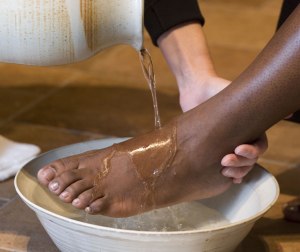 13 Before the Passover celebration, Jesus knew that his hour had come to leave this world and return to his Father. He had loved his disciples during his ministry on earth, and now he loved them to the very end. 2 It was time for supper, and the devil had already prompted Judas, son of Simon Iscariot, to betray Jesus. 3 Jesus knew that the Father had given him authority over everything and that he had come from God and would return to God. 4 So he got up from the table, took off his robe, wrapped a towel around his waist, 5 and poured water into a basin. Then he began to wash the disciples’ feet, drying them with the towel he had around him.
6 When Jesus came to Simon Peter, Peter said to him, “Lord, are you going to wash my feet?”
7 Jesus replied, “You don’t understand now what I am doing, but someday you will.”
8 “No,” Peter protested, “you will never ever wash my feet!”
Jesus replied, “Unless I wash you, you won’t belong to me.”
9 Simon Peter exclaimed, “Then wash my hands and head as well, Lord, not just my feet!”
10 Jesus replied, “A person who has bathed all over does not need to wash, except for the feet, to be entirely clean. And you disciples are clean, but not all of you.” 11 For Jesus knew who would betray him. That is what he meant when he said, “Not all of you are clean.”
Comments
“Unless I wash you, you don’t belong to me.” This has been a recurring theme in the Gospels this year, but it finds no fuller expression than right here. Peter was not only one of the Twelve, he was also one of the three, clearly one of Jesus’ closest companions. And yet, Jesus is adamant with Peter, the foot washing thing is a deal breaker. This is often true of following Jesus, it is an all or nothing proposition. We don’t like that because it sounds so harsh. But it is a common trait of love. Love is an all or nothing deal. Think about it, there are a list of things that would instantly end a marriage. Not just one thing, but a whole list of things that are deal breakers. As we will see tomorrow, Jesus is giving an object lesson for one of his most important teachings: what it looks like to be a leader in his church. He is telling Peter, “You will either learn to lead like this, or you can leave now.” I wish more church leaders understood this and felt this level of pressure to be servants. That alone would bring a renewal like we haven’t seen in years.
We talk a lot in the Vineyard about being “centered set,” the idea that each of us is either moving toward Jesus or away from Jesus, that there is no “in” versus “out.” It can seem like what I’m saying here works against that: being kicked out only seems possible in a bounded set, right? But I don’t think so, because the main feature of a bounded set mentality is the idea that there is a safety zone. Whether it’s saying the sinner’s prayer, getting baptized, taking communion, speaking in tongues, or whatever, bounded set looks for some line that once you cross in, you’re safe. You have arrived. You can relax. But there is no safety zone, no inner circle that brings a guarantee. We either keep following Jesus or we turn away. A marriage certificate doesn’t guarantee a life long marriage, only the day in, day out hard work of loving someone through self-sacrificial serving does that.
What we really have here is Peter holding out on Jesus. Peter treasured a false sense of humility (which is really just a form of pride) and special piety and Jesus demanded he give that up. Love is always like that, it is always jealous. It will find what we hide and demand it from us. Whatever we try to store away in emotional lock boxes, we can be sure Jesus will come after. Because he loves us and wants to heal us of our crap and won’t let us settle for a halfway relationship with him.
Peter responded by jumping from one extreme to the other – wash all of me – from false humility to spiritual excess. What Peter really wanted (and here the pride really shows through) was not to be like the rest of the Twelve. He wants to be distinct. He thinks he’s ready to die for Jesus (we will read that at the end of this chapter) to follow beyond what anyone else will do. If he can’t express that through out-humbling the others, then he will do that through excess. Spiritual excess is always with us, as anyone from a Pentecostal or charismatic background can tell you. We don’t need John MacArthur to run out an expose about it, we are well aware. But none of that negates the reality of the Spirit moving in power. Peter wanting a full bath doesn’t negate what Jesus is doing with this foot washing. Jesus basically told Peter to “settle down,” which is a message some charismatics (and their vociferous detractors) need to hear.
Finally for today, take note of “not all of you are clean.” That’s right, Jesus washed Judas’ feet. That did not make Judas clean because even when Jesus performs a religious ritual, there is no magic. Having your feet washed by Jesus won’t make you clean. The power is in the symbol, in the enactment and how performing it influences how we think and act. Jesus washes the feet even of his own enemies. If we could learn to wash the feet of our enemies, we would see the Spirit move like we have never known. If you don’t believe that, take 30 minutes and listen to the story of the Memphis Miracle: http://agtv.ag.org/vp-don-evans
New Living Translation (NLT) Holy Bible. New Living Translation copyright© 1996, 2004, 2007 by Tyndale House Foundation. Used by permission of Tyndale HousePublishers Inc., Carol Stream, Illinois 60188. All rights reserved.

 Mike Raburn
You must be logged in to post a comment.