
Mark 10:1-16
10 Then Jesus left Capernaum and went down to the region of Judea and into the area east of the Jordan River. Once again crowds gathered around him, and as usual he was teaching them.
2 Some Pharisees came and tried to trap him with this question: “Should a man be allowed to divorce his wife?”
3 Jesus answered them with a question: “What did Moses say in the law about divorce?”
4 “Well, he permitted it,” they replied. “He said a man can give his wife a written notice of divorce and send her away.”
5 But Jesus responded, “He wrote this commandment only as a concession to your hard hearts. 6 But ‘God made them male and female’ from the beginning of creation. 7 ‘This explains why a man leaves his father and mother and is joined to his wife, 8 and the two are united into one.’ Since they are no longer two but one, 9 let no one split apart what God has joined together.”
10 Later, when he was alone with his disciples in the house, they brought up the subject again. 11 He told them, “Whoever divorces his wife and marries someone else commits adultery against her. 12 And if a woman divorces her husband and marries someone else, she commits adultery.”
Jesus Blesses the Children
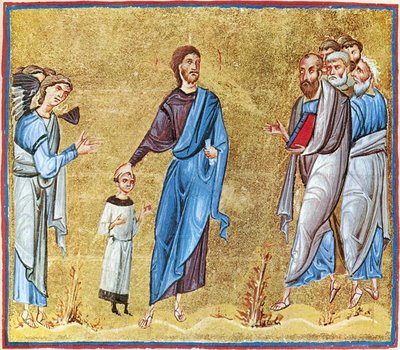
 13 One day some parents brought their children to Jesus so he could touch and bless them. But the disciples scolded the parents for bothering him.
14 When Jesus saw what was happening, he was angry with his disciples. He said to them, “Let the children come to me. Don’t stop them! For the Kingdom of God belongs to those who are like these children. 15 I tell you the truth, anyone who doesn’t receive the Kingdom of God like a child will never enter it.” 16 Then he took the children in his arms and placed his hands on their heads and blessed them.
Comments
If we’re going to do this thing all year – read through the Gospels slowly and completely, we are going to have days like this, where at least part of what we read makes (at least some of) us uncomfortable. It makes me uncomfortable because I don’t know who all will see this, what all you have been through, what hurt you have been subjected to by people purporting to teach you how to live based on the Bible. Divorce affects so many people in our day, many of whom have been further hurt by churches and Christians shunning them, condemning them, making them feel like they are forever damaged, forever second class. If we took the first part of today’s reading alone, we might see how some come to view this issue so rigidly.
But for days and days now we have seen Jesus consistently breaking down the clean/unclean distinction, the acceptable/unacceptable, the insider/outsider, the righteous/sinner. If he is now suddenly shifting toward a condemning posture that would mark a serious break from everything we have read so far. It also wouldn’t fit well with the very next story where Jesus goes out of his way to welcome children. This probably doesn’t seem as radical to us in a culture that values youth and children so highly (which is a good thing!). In his day, children were not valued so highly. The disciples thought they were doing a good, right, and very practical thing in filtering the children out. Jesus surely didn’t have time for them. I’ve speculated about Jesus’ mood in these stories since we started, but here at last Mark tells us directly – Jesus got angry. The disciples have failed to unterstand the most basic part of the Gospel – that all are included, that no one is excluded based on any criteria. Jesus sees them turning away the most vulnerable of all and he gets mad. So mad, he threatens them with missing the kingdom altogether.
So we have to go back and understand the divorce part in light of this kingdom-for-all posture Jesus is consistently taking. Divorce is bad. Divorce involves sin (often on multiple parties). But it is no more a criterion for exclusion from Jesus and his kingdom than anything else. He doesn’t argue for a stricter standard than Moses so he can condemn people Moses would let through, he holds to the original standard because it is the ideal, it is the only good way, and because anything short of the ideal is covered by his grace, not Moses’ legal exemptions.
One other thing to note: the law Jesus is referring to is found in Deut. 24.1-4. This is part of the Law, given to Israel by God through Moses. That is how it is explained in the Hebrew Bible/Old Testament. Not as something Moses wrote or came up with, but as the very Law of God. Psalm 119 spends an incredible 176 verses eloquently making this very point. And yet, Jesus demotes the law in this case as something less binding than how things were made to begin with, as though the entire law were a concession, a stop-gap measure. Jesus feels perfectly free to put the law in dialogue with the creation narratives and find the narrative more authoritative. In short, Jesus claims the authority to interpret Scripture and adjudicate when different passages are in contention. As we have seen, the crowds recognized this authority early on; it was part of what attracted them to his teaching. As in all other things, the authority Jesus claimed for himself and exercised is the same authority he passed on to his followers.
New Living Translation (NLT)
Holy Bible. New Living Translation copyright© 1996, 2004, 2007 by Tyndale House Foundation. Used by permission of Tyndale House Publishers Inc., Carol Stream, Illinois 60188. All rights reserved.
 36 Then he put a little child among them. Taking the child in his arms, he said to them, 37
  Mike Raburn
You must be logged in to post a comment.